
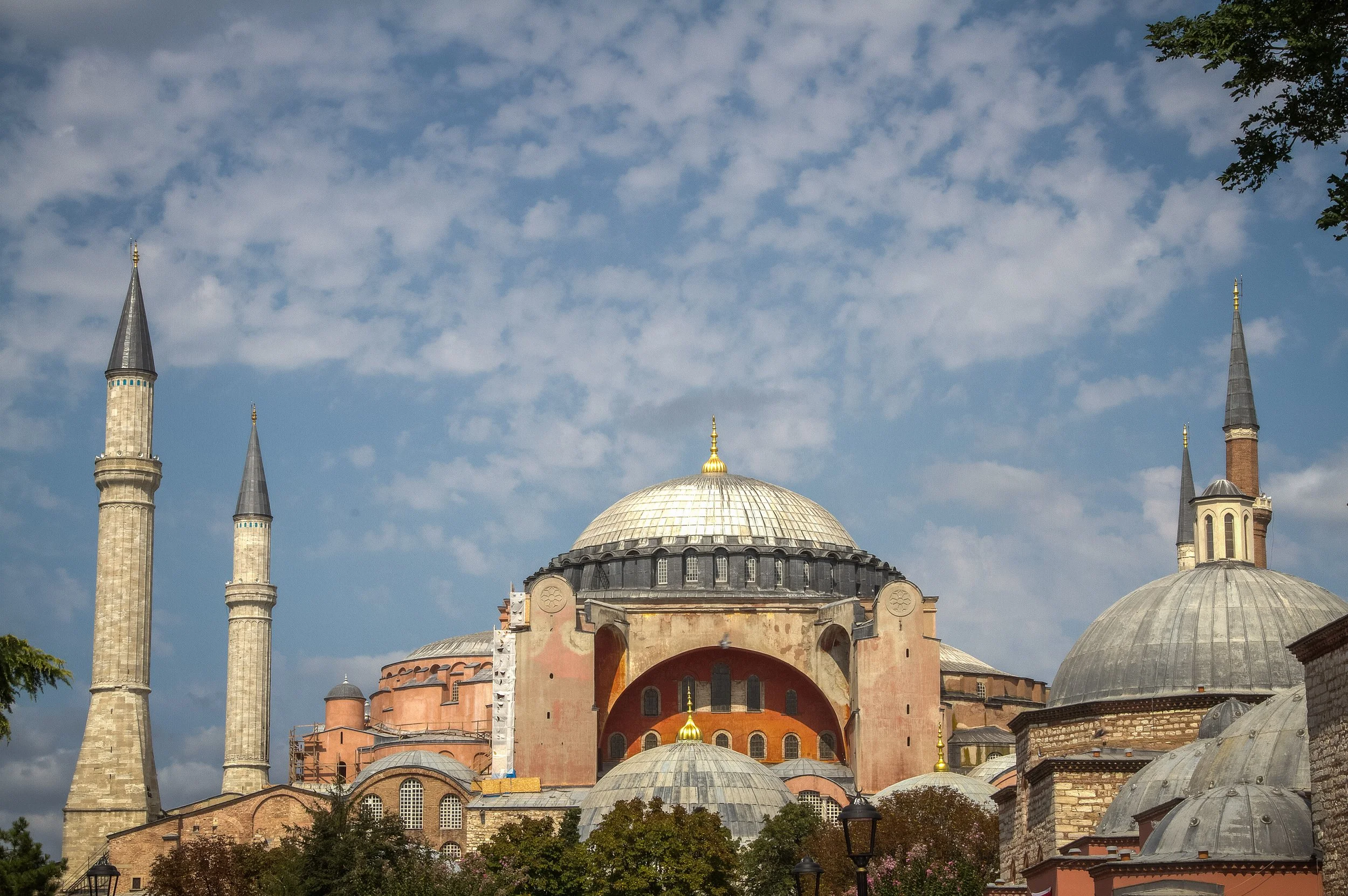
I've been to Istanbul over 25 times. And for most of those visits, walking into the Hagia Sophia felt like stepping into one of the most honest conversations a building had ever tried to have with me.
That space doesn't whisper. It announces. The dome sits nearly 200 feet above you, and it doesn't ask permission to make you feel small. There are Byzantine mosaics of Christ and the Virgin Mary that survived centuries of conquest and whitewashing, windows that flood the floor with light, and an architecture that somehow belongs to no single era because it was extraordinary enough that every civilization that touched it decided to keep it. The Byzantines built it. The Ottomans kept it and transformed it. Atatürk made it a museum so that all of humanity could walk inside and try to understand what it means to build something that outlasts the reasons you built it.
Then something changed.
In 2020, Turkey reconverted the Hagia Sophia from a museum back into a functioning mosque. And I want to be careful here, because my argument is not with Islam and it's not with Turkey's sovereignty. Nations have rights. Cultures have legitimate claims to their histories. I understand that, and I mean it. But here's what actually changed for the traveler standing at the door: the ground floor, the main prayer hall, the place where 1,500 years of human ambition lives in stone and tile and light, that space is now restricted. Non-Muslim tourists are channeled to the upper gallery. You pay 25 euros for a partial view of something that used to be fully open to every human being who showed up curious.
And I stood there thinking: who does this building actually belong to?
Here's what makes that question harder to dismiss. Directly across the plaza from the Hagia Sophia stands the Blue Mosque. Also, a functioning mosque. Also, an active place of daily prayer. And tourists can walk into the main prayer hall. The iconic interior. The space that defines the building. You just have to go outside of prayer times. You cover your shoulders and your knees. Women wear a headscarf. You remove your shoes. And it's completely free.
That comparison matters. Because what it tells you is that the restrictions on the Hagia Sophia aren't simply what it looks like to operate a mosque. The Blue Mosque is proof that you can run an active, reverent house of worship and still welcome the world into it. The access policy at the Hagia Sophia is a choice. And choices, especially ones made about places that belong to everyone, deserve to be examined. That's not a rhetorical question. I mean it as a philosophical one. Because I think we've been having the wrong conversation about ownership when it comes to certain things in this world.
We talk about cultural heritage as if every object, every structure, every wonder automatically belongs to whoever holds the deed. And sometimes that logic works fine. A country's parliament building belongs to that country. A family heirloom belongs to that family. Reasonable. Agreed.
But there's a different category of thing. A category where the creation has so thoroughly escaped its creators, where its meaning has spread so far across time and across peoples, that ownership starts to become the wrong word entirely. Some things were made by a specific people, in a specific moment, but over the centuries they became something that belongs to the story of all of us.
The Hagia Sophia is one of those things. It was built by a Byzantine emperor. It was the seat of Eastern Christendom. It was transformed by Ottoman architects who added minarets and their own layer of genius. It spent 86 years as a museum that welcomed everyone. At this point, it belongs to all of those histories simultaneously. Restricting access to it doesn't protect one of those histories. It just chooses one over the others.
---
This tension shows up everywhere if you start looking for it.
Take the Parthenon Sculptures. You probably know them as the Elgin Marbles. They're sitting in the British Museum in London right now, have been since the early 1800s, when a British ambassador used his access to the Ottoman-controlled Acropolis to remove a substantial portion of the surviving sculptures and ship them to England. Greece has been asking for them back ever since. The debate has been running for over 200 years.
And here's the interesting part: both sides justify their position using almost the exact same language. The British Museum says the sculptures belong to humanity and that London is where the most people can access them. Greece says the sculptures belong to the people whose ancestors made them and that fragmenting a unified work of art is its own form of destruction. Both arguments are about access. Both arguments are about meaning. Neither argument is really about a deed or a title.
What strikes me is the question underneath that debate: does proximity to creation give you a permanent exclusive claim? Or does the magnitude of a creation eventually make it everyone's inheritance?
I don't think there's a clean answer. But I think the question is worth thinking about.
---
Then here's Lascaux. Deep in the Dordogne region of France, there are cave paintings made by our ancestors roughly 17,000 years ago. Six hundred paintings, 1,500 etchings, depicting horses and bison and deer with a sense of movement and depth that we associate with modern art, not with the Stone Age. They were rediscovered in 1940 by four kids following a dog into a hole in a hillside. Within a few years, they'd opened it to the public. Within two decades, they had to close it entirely.
The breath and body heat of human visitors were destroying the paintings. Mold. Fungus. Irreversible damage. So France made a decision: the original cave is now closed to everyone except a small team of conservators. Five people per day, for less than an hour. Everyone else gets a replica.
And here's the thing I keep thinking about: the French didn't close Lascaux because they wanted to keep it to themselves. They closed it because they understood that some things are too important to be consumed by the very love people have for them. That's a different kind of stewardship. Not restriction out of ownership, but protection out of responsibility.
Those caves don't belong to France. They belong to the entire human story. France just happens to be the place where they're physically located, which makes France responsible for them, not the exclusive heir to them.
There's a difference between custodianship and ownership. And I think we've been blurring that line for a long time.
---
I want to be fair here, because this is genuinely complicated. There's a real argument to be made that certain sacred sites require a level of reverence that mass tourism simply can't provide. That when millions of people pass through a space holding cameras and noise and no particular connection to what it means to pray there, something is lost. That indigenous communities and religious communities have been told for centuries that their sacred places are public spectacles, and that some of the resistance to universal access is a response to centuries of that. I hear that. I think that's true.
But I also think there's a way to honor the sacred without erasing the shared. You can have prayer hours and visiting hours. You can have dress codes and codes of conduct. You can build infrastructure that lets a Muslim pray in peace in the Hagia Sophia and also lets a traveler from São Paulo who studied Byzantine art for twenty years stand in the nave and weep at what human beings are capable of building. Those things don't have to be in conflict.
We already know this is possible. The Blue Mosque is right across the plaza, and it proves it every single day.
The Lascaux solution, as painful as it is, points toward something else entirely. When you can't reconcile access and preservation, you find a way to preserve the thing itself while creating meaningful, honest access to what it represents. You don't just say: this is ours now.
---
What I'm really arguing for isn't a policy. I don't have a UN proposal. I'm arguing for a way of thinking. Some things transcend the accident of where they were built or who built them. They become part of the vocabulary of being human. The Hagia Sophia is one of them. The Parthenon is one of them. The Lascaux caves are one of them. Machu Picchu. The Great Barrier Reef. The Serengeti. These are not national assets. They're evidence of what this planet is, what our species has done, what time and nature and human ambition are capable of producing together.
And when we treat them purely as property, we diminish them. We take a conversation that was meant for everyone and we put it behind a door and we hand one group the only key. I walked out of the Hagia Sophia on that last visit and I felt something I hadn't expected to feel. I felt sad for the next generation of travelers. Not because they can't enter the building, they can. But because they'll enter it with a ceiling already placed on what they're allowed to experience. And ceilings in sacred spaces feel like a particular kind of wrong.
Some things were made by people. But some things belong to all of us. I think the Hagia Sophia is one of them. And I think it's worth asking, every time we put a lock on something that size, who exactly we're protecting, and who we're leaving outside.
Leave The World Better Than You Found It.
